
M. L. Longworth

On food, writing and life in the south of France

La Cadière d’Azur

We’ve sold our house in Aix-en-Provence and bought a house, surrounded by vineyards, in the countryside south of Aix. Call it a mid-life crisis or empty-nest syndrome if you will–our 20-year-old daughter has lived in London for two years. But we also saw it as a chance to live in the country, and to reduce our mortgage (houses are cheaper the further away you get from prestigious Aix).

We can’t move into the new home until the end of July; so we’re in a rented apartment in a stunning  hilltop village, La Cadière d’Azur. Much lesser known than its neighbor, Le Castellet (stay away, unless you enjoy phony villages where no one lives anymore; the boutiques all sell identical tacky souvenirs; and the restaurants serve you up a delicious frozen, and then microwaved, meal). And you have to park in the official parking lot; after doing a tour of fifteen minutes, I was amazed that I owed the town € 3,40 for the pleasure.

The sun has finally come out, and so I walked around La Cadière this afternoon with a camera around my neck.

The main street, with the town hall, two cafés, a wine bar, and a smattering of independently owned shops.


A tiny road above the town, looking towards the church. Great medieval house on the left, with a curved turret.


You could smell these climbing roses from a few yards away; the blue door is lovely, too.


A polished brass door knocker.


Another one…


The boulangerie; the bread is baked in a wood-fired oven.


The gates that lead to the upper streets.


The view from La Cadière d’Azur across the valley, and the many vineyards (AOC Bandol) below. The perched village on the top right is Le Castellet.


Turning around from the valley view, and looking up at the church.


Notice all of the benches; there must be fifty in this small village. In Aix there were fewer: poor form  for a city ten times (or more) the size of La Cadière. In Aix, you had to race if you saw a free spot on a bench. High school and university students were usually reduced to sitting on steps to eat their sandwiches. I admire a place where you don’t have to order a drink for the right to sit down.

More photos to come!

The Waking Bee

“The waking bee, still drowsy on the wing,

Will sense the opening of another year

And blunder out to seek another spring.”

The poet, novelist, and gardener Vita Sackville-West wrote that in 1926, as part of her anthology of poems, The Land. I love how she has the bee ‘blunder out’; they do do that, don’t they, as they sometimes fly sideways over your patio table and then look like they’re about to crash. I enjoy how she dares to repeat ‘another’, too. It works.

This spring brings changes for our family; we’ve sold our small city house in Aix-en-Provence in exchange for an even smaller country house, south of here, surrounded by the vineyards of AOC Bandol. Call it mid-life crisis if you will, or empty-nesters’ syndrome (our daughter, 20, is studying at UCL in London). My husband and I both wanted to feel more connected to the land (otherwise, we argued, we should just live in Paris); we’re looking forward to seeing the seasons change–really seeing them change–or as Sackville-West wrote: “I sing the cycle of my country’s year.”

We felt that, in town, we were living too often in-doors, which seemed silly in Provence. So gardening books now cover the coffee table as our interests turn outside. I’ve always wanted to visit Sackville-West’s gardens in Kent:

Vita Sackville-West’s gardens at Sissinghurst, Kent.

And also the gardens at La Louve in Bonnieux, in the Luberon:

La Louve, Bonnieux, Provence. A symphony of greens; no flowers.

Our garden will, alas, not look like either of these gardens, but it will take us outside. This decision to move took about six months, with lots of back-and-forth hesitations: listing all the things we’ll miss about city life (seeing films in their original language at Aix’s great cinema Mazarin, our friends, Aix’s busy restaurants and cafés) and the things we’ll gain by living in the country (peace, great views, village markets…). But the closest baguette is a two-mile walk.

Have you made this change, from city to country? Or vice versa? If you have some words of wisdom, or advice on moving from city to country, I’d love to hear it. A friend cautioned, “At first, the county will be so quiet, you’ll have to have the radio on all the time.”


Andy Warhol’s Marilyn: Looking at Biographies

Warhol’s silk screen of Marilyn Monroe, 1962; Tate Modern, London.


Yesterday was the first day of class at N.Y.U. Paris. I got a lot of writing done in January, but after a month off, it’s always great to see the students once again. Everyone says that writing is a lonely job, and it is, so it’s wonderful to be able to teach writing to eager, bright, and funny, students.

Our first essay this semester is a biography. We began in September with memoir (what an honour for me to read their essays) and so biography is a natural follow up in what is Life Writing. To get the students thinking about biography, I gave each one this colour photocopy of Warhol’s Marilyn. I gave them a few minutes to study the piece, and then told them to write down as many words as they could that the art work revealed about our illustrious film star. Given that N.Y.U.’s students are from all corners of the globe, and that these particular students are freshmen, some of them weren’t quite sure what exactly Marilyn did. Most knew that she was a sex symbol, but some hadn’t realized that she acted. Or which decades she lived in. Or who she was married to (although many knew of her Kennedy lovers). So they had to depend almost solely on Warhol’s art.

A lively discussion followed, and we spent an hour trying to vocalize what Warhol’s art revealed, or didn’t, about Marilyn. Some of the students’ words: Sex, blonde, media, fame, façade, icon, myth, jarring, fading, asleep, Hollywood, bi-polar, repetitive,… There are fifty identical images of her (yet not all identical if you look closely, for Warhol varied the amount of paint on each image); the colours used on the left are jarring, garish. And then the black and whites, some of them blacked out (her secret life, her anguish) and then, finally  fading away into nothingness. “A life ended too soon,” one of the students said.

Warhol was obsessed with fame, and how it reflects our society (this greatly interested the students). He began a series of over twenty silk screens of Marilyn in the year she died, 1962. We talked about her life, and came to the conclusion that despite our animated discussion, Warhol’s silkscreen revealed so much and yet nothing about our film star. And we agreed that there was genius in that.


A Friend is Knighted!

Last knight our friend Blandine Chelini-Pont was Knighted! Her official title: Chevalier de l’Ordre National du Mérite de la France. I took this photograph with my cell phone, so the quality isn’t that great, but her blue medal sure comes shining through! She was Knighted for her research, articles, and teaching in 20th century history and theology.

As is the case with people who are graceful and modest, we friends didn’t know of half her accomplishments until her biography was read aloud by the Mayor of Marseille.

A wonderful champagne reception followed in the palace of the Pharo, overlooking Marseille’s old port.

Built in 1855 by Louis Napoléon Bonaparte for the Empress Eugénie, the Pharo was later used as a faculty of medicine, and is now a reception and conference centre. Here’s the view from the terrace of the Pharo:

Congratulations, Blandine! Your friends from Aix are very proud of you!


Where Writers Write

“The daily act of writing remains as demanding and maddening as it was before, and the pleasure you get from writing–rare but profound–remains at the true heart of the enterprise,” writes Jeffrey Eugenides. “On their best days, writers all over the world are winning Pulitzers, all alone in their studios, with no one watching.”

I’ve never thought of winning a Pulitzer, but where I write is very important to me. It’s also a lonely time, as Eugenides says, which is why I like teaching. Where do you go to write, or read, or think?

Here’s a photo of where I write at home in Aix-en-Provence. The desk has been cleaned for company coming for dinner that evening!

I love this photo of E.B. White, writing:

Here’s another place where I often write, twice a week, for three hours each stretch of the way:

The TGV; three hours from Aix to Paris.


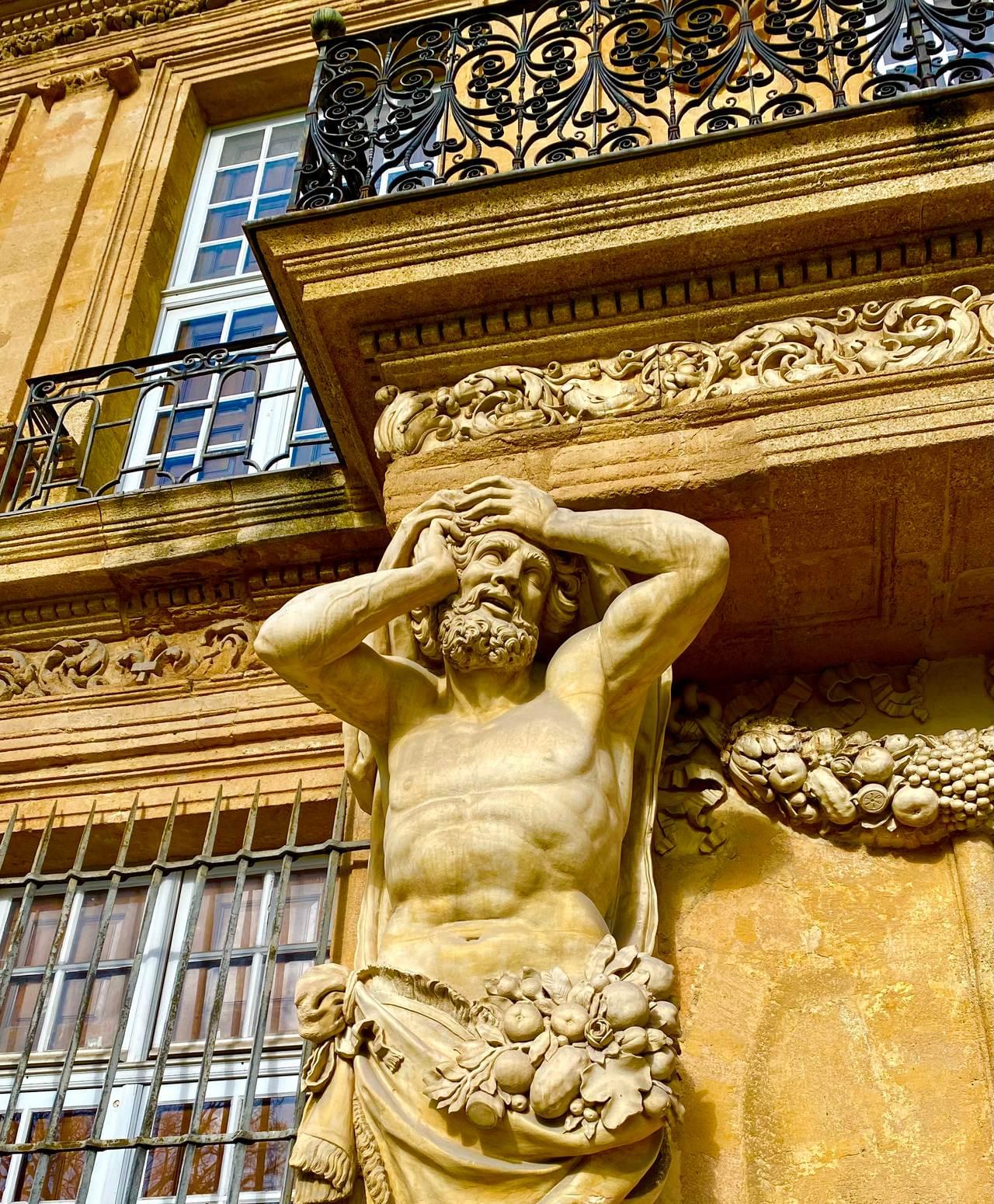
And this writer wrote, for hours at a time, shifting his weight from one leg to the other, standing up. Do you know who it is? Hints: it’s hot out, and his legs are very muscular!

The Cheese Dinner

Charlotte, a friend’s daughter, with our dinner.

Last night we were invited to a friend’s in Marseille for a dinner that consisted solely of cheese (with a green salad thrown in).

There were five platters of cheese. We began with hard cheeses from the Alpine regions of France and Switzerland: Gruyère, Tomme de Savoie, and Cantal (from the Massif Central), partnered with a crisp white Sauvignon Blanc from the Loire Valley.  Then came several Chèvres from Provence and the Loire, (including a personal favorite, the pyramidal-shaped Pouligny-Saint-Pierre), all of which went down beautifully with a 2003 Chablis. Next, cows’ milk creamy cheeses: Camembert, St Félicien (from Hautes Provence) and a beautiful heart-shapped cheese Neufchâtel from Normandy, accompanied by a spicy red Côtes du Rhone from Gigondas. Four blue cheeses came next (with the same wine), and finally, with an old Bordeaux, the ‘strong cheeses’ as our host Thierry referred to them: Langres (from Champagne), Morbier (Franche-Comté), Epoisses (from Burgundy) and a Boulette d’Avesnes which is cone-shaped and covered in paprika.

Boulette d’Avesnes from Northeastern France near the Belgian border.


If you’re interested in French cheeses, this is the book I’d recommend buying (our host Thierry had the French version and we referred to it during our meal):

And what to do with those bits of left-over cheeses, especially the tasty rinds? Make a Provençal Cachaio (or, Patafine as it’s called in La Dauphine, or Fromage Fort in Burgundy):

Put together the rest of the cheeses with four or five garlic cloves, olive oil, l’eau de vie (clear alcohol such as grappa), white wine, and a sprig of thyme, fennel, and a bay leaf. Grate in some fresh pepper and store in a dark place for at least two months. Spread on bread or crackers to eat.

And, as Thierry suggested, don’t eat the Cachaio before a first date or a job interview.

Bon Appétit!

Ales and Books in London

For fans of Jack Kerouac’s ‘On the Road,’ his 120-foot long typed scroll, written in three weeks when he was ‘fuelled by coffee,’ is on display at the British Library. For those of you arriving in London via Paris on the Eurostar, the library is beside St Pancras station. Both buildings are clad in red brick but the BL is very much modern next to its Victorian neighbour (St Pancras was saved from demolition….thankfully, as it’s the most elegant train station I’ve ever been in, and it has a champagne bar).

‘On the Road’ scroll (Private Collection)

Also in the British Library is the Ritblat Gallery, a treasure trove of manuscripts in all of their forms: quickly written WWI poems scrawled down on bits of paper while in the trenches; the lyrics to ‘A Hard Day’s Night’ jotted down on the back of a birthday card; handmade books from every era; and illuminated manuscripts such as the Lindisfarne Gospels, a personal favourite, and one that my 19-year-old daughter said looked very contemporary:

Lindisfarne Gospels; England c. 700 AD

I love this photograph of Andrew Motion, a former Poet Laureate of England, paused in front of the library (the photo comes from my favourite magazine, The Economist’s Intelligent Life):

Andrew Motion at the British Library

After gazing at books we took a London Walks tour (highly recommended!) that featured three pubs along the Thames: one for the view, one for the beers (ales I should say), and one for its history. We began by having a pint of bitters at the Blackfriar pub, not on the tour because it’s so well known. Located on the same spot where monks, who wore black robes, prayed and made beer in the middle ages, the pub is an Art Nouveau masterpiece (built in 1905). Like St Pancras, it too was saved from demolition, in the 1960s by the poet Sir John Betjeman. So, you see, books and poets and ales do have something in common. ;)

Black Friar Pub, London

The Old and the New in Aix, Part II

Le Rectorat, Aix’s education authority building, had just been given a fresh coat of paint (it has a small role in my second book, Murder in the rue Dumas). All of a sudden, its 1970s exterior no longer looks so shabby. It proudly stands beside its neighbors: a 1940s university student residence, and on the corner, an elaborate ‘faux château’ built in the late 1880s, now home to the region’s notaries.

le Rectorat

Cité d'universitaire (student housing)

headquarters for the region's notaries

I love that these buildings have been saved and are still in use, despite the fact that Aix is more famous for its 17th and 18th century architecture. Some cities, like Santa Barbara, California–a beautiful city–have strict building codes, where architects and planners have to adhere to a pre-decided look. Do you think that that’s a good thing? It’s a tough call; I see both arguments.

And across the street from the notaries’ building is a new jewel, built in 2010 by local architect Antonio da Silva-Ascençao: an extension to an underground parking garage.

Parking Mignet, Aix-en-Provence

Da Silva-Ascençao has playfully inserted a wall of colored windows–as you walk into the garage–where one can watch the students running around in the courtyard of College Mignet (a middle school that was attended by Paul Cézanne and Emile Zola in the late 1800s, and more recently, our daughter!).


Parking Mignet extension at night. Stunning!

If you know of an equally beautiful parking garage, or one that rivals this one, I’d love to see it!

So within a 200-meter radius all kinds of eras clash, and get along quite well: 1880s, 1940s, 1970s, 2010, and peeking up just beyond the glass and steel parking garage: the 12th century stone spire of St-Jean de Malte church. Vive la différence!

A Mystery Café in Aix-en-Provence

Our local Anglo bookstore in Aix, Book’in Bar, called me the other day to come in and sign a few copies of my books for a fan who was visiting from the U.S. I didn’t get to meet the fan, but she left me a note saying that she and her daughter and granddaughter had had fun exploring Aix, trying to find some of the spots highlighted in my Verlaque and Bonnet mystery books. They found most of them, but not the Mazarin Café, Marine and Antoine’s meeting place.

The café exists but it isn’t called the Mazarin. I gave the café a fictional name at the last minute; I’m not sure why…perhaps because I had read about an English author being sued by a Parisian textile shop for mentioning their store in her book (and apparently she said great things about the shop, too!).

So, there is no Café Mazarin in Aix…but it is in fact this charming café, pictured below, on the Cours Mirabeau.

the warm interior of the Café 'Mazarin'

The terrace; cigar friendly :)

My favorite time of the day to go to the café is in the early morning. Their coffee is so-so, but they have fresh-squeezed orange juice and the extra-buttery croissants come from  Aix’s best bakery almost across the street. I call it ‘Michaud’ in my books, but that’s not its real name…

Paris in the fall

The garden at NYU Paris

The first day of school at NYU’s Paris campus, in the Passy neighborhood of the city. A chance to see colleagues after a long summer (spent, for most of us, writing and or researching); a chance to pop into a few of the very chic shops on the rue Passy (never buying anything); a chance to meet new students, who come from all over the world, and for many French will be their third or fourth language; a chance to spend way too much time photocopying….School has begun.